Written by: Ochoga E. Ochoga, PhD
My heart bleeds profoundly over the relentless and senseless killings that have ravaged Idoma land in recent days.
These acts of violence are not only disheartening but also wholly unprovoked, casting a heavy shadow of grief and despair upon a people who now appear helpless, abandoned, and bereft of hope.
It is deeply unsettling to observe the eerie silence from those entrusted with authority individuals who, rather than defending the lives and dignity of their constituents, seem to have chosen cowardice or complicity, driven perhaps by political expediency and the desire to curry favour with northern oligarchs.
While the blood of innocent Idoma sons and daughters flows freely, the very leaders who ought to offer them protection remain indifferent, leaving the people to seek solace in divine intervention. This, indeed, is the true definition of a tragedy, a travesty of responsibility and a dark moment in our collective history.
If both the state and federal governments have utterly failed to uphold their constitutional duty of protecting lives and property, then it stands to reason that our traditional institutions, at the very least, must rise to the occasion.
The role of the traditional authorities has never been more crucial. It is within this context that the palpable anger of the Idoma people over the past few days must be understood. Social media platforms have become battlegrounds of discontent, with sharp criticism directed at the person of the Och’Idoma.
While some interpret this as an affront to the revered institution of the Idoma monarchy, it is imperative to look beyond surface interpretations and examine the underlying causes of such widespread disapproval.
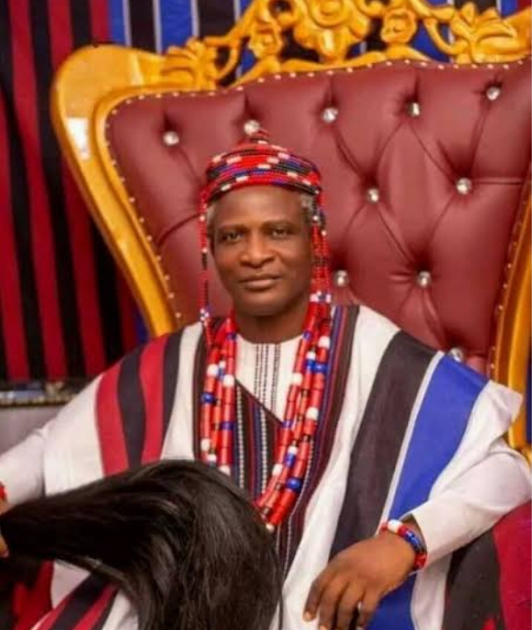
To many Idoma sons and daughters, the current Och’Idoma is not perceived as a true spiritual and cultural embodiment of Agaba-Idu. Instead, he is derisively referred to as an “Agaba-Ortom,” a sobriquet that encapsulates the belief that he is the political creation of former Governor Samuel Ortom and his cohort of Idoma loyalists.
This perception is further reinforced by the fact that the legal and procedural framework which birthed his ascension to the throne is seen as alien, artificial, and imposed a sharp departure from the indigenous customs and traditional norms that have historically governed the selection of the Och’Idoma. Thus, the root of the crisis lies in what scholars of political science aptly describe as a “crisis of legitimacy.”
The relentless outbursts on social media should therefore not be mistaken for mere irreverence or rebellion. Rather, they reflect a deeper, more painful rejection—not of the stool itself, which remains sacred and revered but of the current occupant, whose presence is viewed as a desecration of its sanctity.
By now, the Och’Idoma ought to have come to terms with the glaring legitimacy deficit that continues to haunt his reign. Indeed, he must be aware, but his posture suggests a stubborn refusal to seek redemption or reconciliation. This intransigence is rooted in what many see as his utter disregard for the cherished customs and spiritual anchors of the Idoma people—principally, Alekwu and Aje.
As long as he continues to turn a blind eye to these fundamental cultural tenets, the people’s criticism should not only be expected but perhaps even welcomed as a legitimate form of cultural self-defense. I recently watched a video clip in which the Och’Idoma stood beside a senator on a public road, completely bareheaded—an act that represents an unacceptable deviation from Idoma tradition, where the head of a king is sacred and must be respectfully adorned, especially in public.
Yet, voices cautioning against criticism of the new Och’Idoma seek to muffle genuine expressions of cultural concern. This is untenable. When a leader refuses to embody the values and symbols of the community he claims to lead, he must be prepared for dissent.
The recent leakage of an audio conversation between the Och’Idoma and a concerned Idoma citizen in the diaspora has only served to aggravate the situation further. That conversation laid bare the growing chasm between the people and their supposed monarch, a man widely believed to have been imposed not to preserve tradition, but to upend it. The people have every right to reject such an aberration, especially when it strikes at the very heart of their identity. It is unfortunate that, instead of embracing humility and seeking a path to legitimacy, the Och’Idoma has chosen arrogance and isolation.
In times of conflict and social fragmentation, the legitimacy of a ruler becomes not only desirable but indispensable. Without it, any form of leadership be it traditional or political becomes a house built on sand.
The burden is therefore upon him to pursue legitimacy, not through legal technicalities or state endorsements, but through genuine engagement with the cultural, spiritual, and emotional pulse of the people he claims to lead.
Until then, the pain and protest of the Idoma people will persist, as they continue to mourn not just their slain brothers and sisters, but the erosion of the very traditions that once gave them pride and strength.