Written By: Patrick Ochoga
Edo State is fast becoming a proving ground for performance driven politics and strategic governance under the leadership of Governor Monday Okpebholo.
From urban centres to rural strongholds, the steady rhythm of construction and renewal now doubles as a powerful political message: governance delivers, and delivery wins loyalty.

At a time when political capital is increasingly tied to tangible outcomes, Governor Okpebholo has positioned himself not merely as an administrator, but as a mobiliser, a party man, and a frontline ally of President Bola Ahmed Tinubu’s Renewed Hope Agenda.
His bold declaration to deliver 2.5 million votes for President Tinubu is not rhetoric floating in isolation; it is backed by visible, statewide performance that is steadily reshaping public perception and political alignment across Edo State.
Barely months into office, Governor Okpebholo has embraced a results-first approach that blurs the line between governance and grassroots politics.
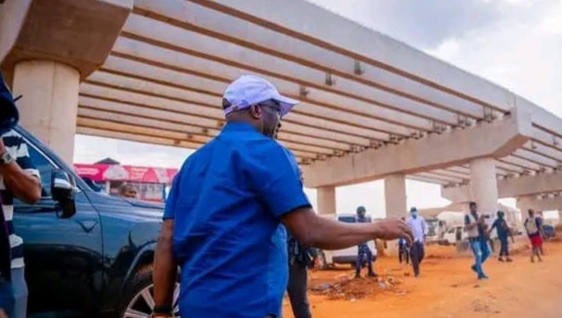
His leadership style marked by frequent, often unannounced inspection visits has become both a governance tool and a political signal.
Contractors know they are being watched. Communities know they are being remembered. Party structures know they have a governor actively strengthening the bond between performance and political loyalty.
Nowhere is this political reawakening clearer than in Edo South Senatorial District, particularly along the once-infamous Benin–Sapele Road corridor. For years, the road symbolised abandonment and voter disillusionment.
Today, its reconstruction stands as a visible rebuttal to opposition narratives and a concrete reminder of what aligned federal and state leadership can achieve.
The road’s rebirth has reignited commerce, restored mobility, and, crucially, rebuilt trust in government.
Traders, transporters, artisans, and residents now associate improved livelihoods with purposeful leadership an association that carries significant electoral weight.
Across Edo South, from Evbhukhu to Amagba, Ohoghobi to Oghehe, Old Sapele Road to Uhie Road, and from Okhabere to Ugbiyoko, infrastructure projects are reshaping not just landscapes, but political conversations.
Strategic landmarks such as the Adesuwa Flyover and Charismatic Renewal Road have become symbols of a government determined to outperform expectations and consolidate popular support.
Education, another politically sensitive sector, has not been left behind. The comprehensive transformation of Army Day Junior and Senior Secondary School, Ekenhuan, sends a strong signal to parents, teachers, and young voters that this administration understands the politics of human capital.
What was once a neglected institution now stands as a model of renewal, reinforcing the narrative that Governor Okpebholo governs with both vision and empathy.
The revival of Oredo Girls Secondary School further strengthens this narrative. By restoring dignity to public education and expanding teaching capacity, the governor is investing in the future electorate while reassuring communities that neglect is no longer state policy.
In agriculture, Governor Okpebholo’s actions carry both economic and political significance. The swift introduction of the Framework for Responsible and Inclusive Land Intensive Agricultural Investments (FRILIA) places Edo State in alignment with global best practices while calming long-standing land tensions that often fuel rural political unrest.
The dramatic expansion of the agriculture budget from ₦6.9 billion to ₦57 billion alongside the deployment of tractors, bulldozers, and revived state farms, positions the governor as a serious player in the national food security conversation championed by President Tinubu.
The results speak loudly in political terms: over 400 hectares cultivated, active harvesting across clusters, and a landmark $100 million foreign direct investment into Presco PLC by SIAT.
In a year when Nigeria attracted just $250 million in total FDI, Edo State’s share stands as a strategic endorsement of stable leadership, improved security, and investor-friendly governance all pillars of the APC’s national narrative.
Edo Central Senatorial District has likewise become fertile ground for renewed political confidence. From the Ekpoma Modern Market to the POWA Shopping Complex, from Ukhun Road to the Irrua, Illeh, Ukhun corridor, and along the Uromi to Agbor Highway, communities now associate infrastructure delivery with political inclusion.
These roads are not just development projects; they are voter connectors linking farmers to markets, traders to customers, and communities to the political centre.
What ultimately sets Governor Okpebholo apart is his governing philosophy: connectivity, inclusiveness, accountability, and speed, all deployed with a clear understanding of their political implications.
Governance under his watch is not ceremonial; it is strategic, visible, and electorally consequential.
Despite criticism from opposition quarters, the governor remains focused and unshaken, steadily converting performance into political momentum.
Observers increasingly describe him as a leader in a hurry not out of ambition alone, but out of a clear recognition that credibility is built before campaigns, not during them.
As Edo State steadily aligns with the Renewed Hope vision at the federal level, Governor Monday Okpebholo is emerging as a cornerstone of APC strength in the South-South laying the groundwork for both developmental legacy and electoral success.
In roads, schools, farms, markets, and restored public confidence, a powerful political message is taking shape: performance is persuasion.
And in the evolving story of Edo’s political future, Governor Monday Okpebholo is steadily earning his place as the leader building Modern Edo State and positioning it as a decisive force in Nigeria’s national political equation.